When Your Child Refuses to Get Dressed

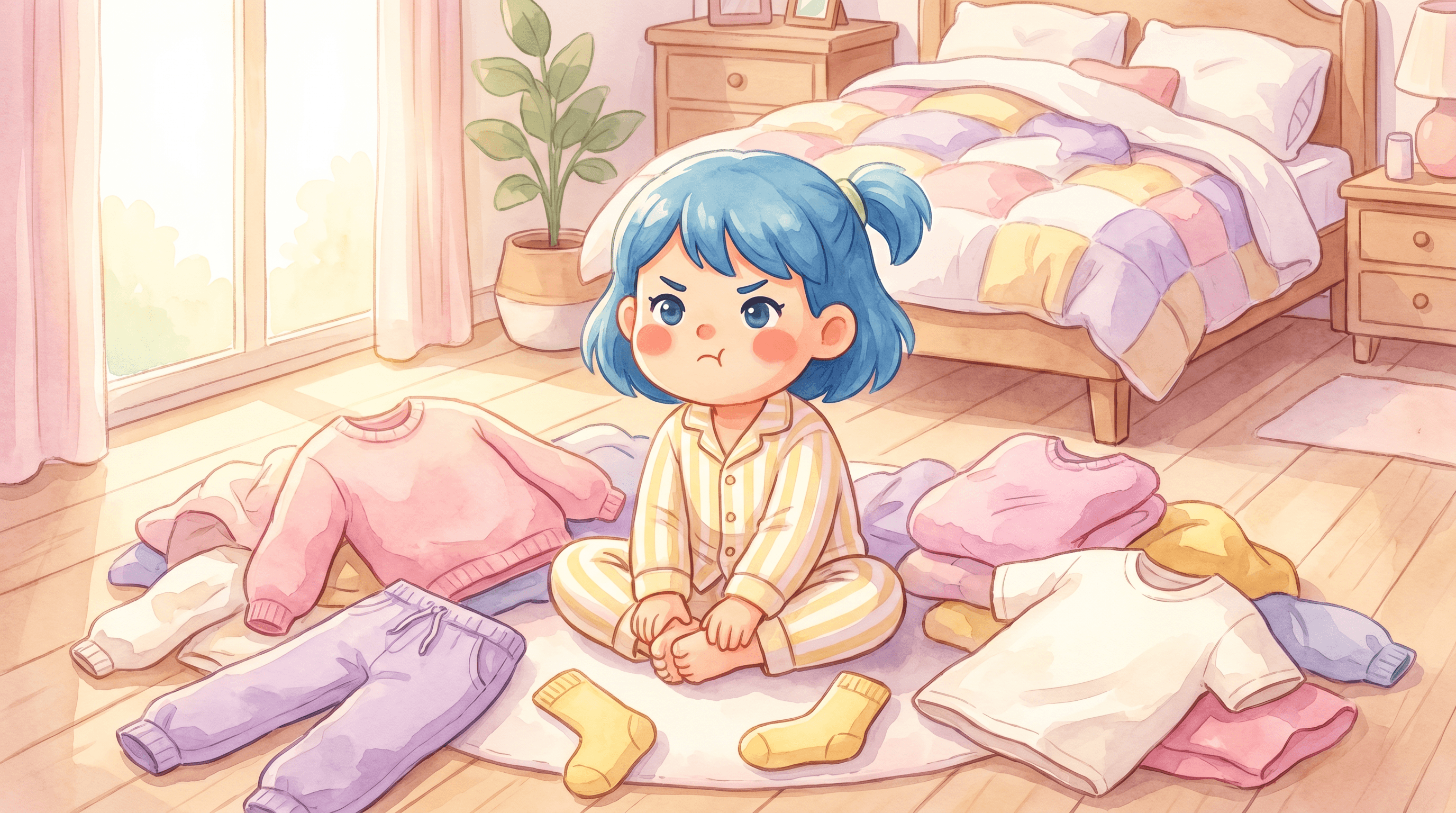
Category: Real-Life Parenting Situations
Subcategory: Morning Battles
Age Range: 3–9
Tags: getting dressed, morning routine, power struggles, young kids, transitions, calm parenting, parenting choices, school prep
Some kids do not say, “I’m overwhelmed.”
They just stop moving.
No shirt.
No socks.
No shoes.
No backpack.
And now everyone is late.
This moment can feel small, but it can become a big fight fast.
What might be happening
Your child may be:
tired
cold
bothered by clothing
wanting control
moving slowly
avoiding school
needing attention
overwhelmed by too many steps
What you can say
“I see you’re having a hard time getting started.”
“We’re still getting dressed.”
“Do you want the blue shirt or the gray shirt?”
“I’ll help with the first step. You do the next one.”
What to try
Use small choices:
“Shirt first or pants first?”
“Sneakers or sandals?”
“Get dressed in your room or the bathroom?”
“Do you want help, or do you want to try first?”
Do not ask:
“Do you want to get dressed?”
Because the answer may be no.
Ask a choice where both options move forward.
What to avoid saying
Avoid:
“Why are you always so difficult?”
“You’re acting like a baby.”
“You’re making everyone late.”
“I’m done with you.”
Those words can turn a slow morning into a hurtful one.
Better words
“This is taking longer than we planned, but we can still fix it.”
“I’m going to stay calm, and we’re going to keep moving.”
“You do socks. I’ll grab your backpack.”
If you are running out of time
You can say:
“I gave you time to choose. Now I’m going to help you get dressed so we can leave.”
That may be needed with younger kids.
Parent reminder
Not every refusal is disrespect.
Sometimes it is stress, tiredness, or too many steps.
Stay clear. Stay calm. Keep the morning moving.
5. When Your Child Says, “Nobody Likes Me”
Category: Real-Life Parenting Situations
Subcategory: Friendship & Self-Esteem
Age Range: 6–14
Tags: friendship struggles, self-esteem, feeling left out, emotional support, school life, child confidence, social skills, parent conversations
Few words hit a parent’s heart like:
“Nobody likes me.”
You may want to fix it right away.
You may want to say:
“That’s not true.”
But sometimes a child does not need a fast answer. They need to feel heard first.
What might be happening
Your child may be:
feeling left out
having trouble with a friend
embarrassed by something
comparing themselves to others
dealing with teasing
having a hard day
feeling lonely, even if people do like them
What you can say first
“That sounds really painful.”
“I’m sorry you felt that way today.”
“Tell me what happened.”
“Was it one person, a group, or the whole day felt bad?”
These questions help you understand the size of the problem.
What not to say right away
Avoid:
“That’s not true.”
“Don’t be silly.”
“You have plenty of friends.”
“Just ignore them.”
Those may be true, but they can feel dismissive.
Better response
Try:
“I know it may not be the whole truth, but it felt true today.”
That is a powerful line.
It helps the child feel understood without agreeing that nobody likes them.
What to try next
Ask:
“Who did you sit with today?”
“Did someone say something mean?”
“Did you feel left out at lunch, recess, or class?”
“Is this the first time, or has it been happening?”
“Is there one person you feel safe with at school?”
If it is a one-day issue
You can say:
“Some days feel lonely. That does not mean you are unlikable.”
“Let’s think of one person you can talk to tomorrow.”
If it keeps happening
It may be time to:
message the teacher
watch for bullying
help your child practice simple conversation starters
invite one kind friend over
check if your child is eating or playing alone often
Parent reminder
Do not rush to fix the feeling.
First, help your child feel less alone with it.
Then help them take one small next step.
1. Parenting Kids Ages 6–10 in 2026–2027: Love, Limits, and Real Life
Category: Parenting Guidance
Secondary Category: Child Development
Tags:
Parenting ages 6–10, modern parenting, family routines, gentle discipline, child behavior, parenting in 2026, parenting in 2027, connection before correction, emotional support, family life
2. Gentle Discipline for Kids Ages 6–10: How to Be Kind and Firm
Category: Discipline & Boundaries
Secondary Category: Parenting Guidance
Tags:
Gentle discipline, discipline for kids, parenting boundaries, kind and firm parenting, child behavior, positive discipline, respectful parenting, consequences for kids, emotional regulation, parenting tips
3. Fun Ways to Build Stronger Bonds With Kids Ages 6–10
Category: Family Connection
Secondary Category: Activities & Play
Tags:
Family bonding, fun with kids, parent child connection, activities for ages 6–10, family traditions, quality time, parenting ideas, play and connection, screen-free activities, building trust with kids
4. Helping Children Ages 6–10 With Big Feelings, Friendship, and Growing Independence
Category: Emotional Growth
Secondary Category: Friendship & Social Skills
Tags:
Big feelings, emotional regulation, friendship struggles, social skills for kids, growing independence, school-age children, child confidence, helping kids cope, parenting support, childhood emotions
5. Supporting Every Child’s Needs With Patience, Love, and Respect
Category: Neurodiversity & Support
Secondary Category: Parenting Guidance
Tags:
Neurodiverse children, autism spectrum support, sensory needs, parenting with patience, child routines, supporting every child, respectful parenting, school-age support, emotional safety, inclusive parenting
1. Parenting Kids Ages 6–10 in 2026–2027: Love, Limits, and Real Life
Parenting children between 6 and 10 can feel like standing in the middle of two worlds.
They are not babies anymore. They can think, question, argue, joke, remember, and surprise you. But they are also still young. They still need hugs, routines, comfort, reminders, and help making sense of big feelings.
In 2026 and 2027, parenting can feel even louder. Kids are growing up with screens, school pressure, fast information, and busy family schedules. Parents are trying to raise kind, strong, respectful children while also keeping up with work, bills, homework, meals, and daily life.
That is a lot.
The good news is this: children still need the same core things they have always needed. They need love. They need safety. They need guidance. They need play. They need adults who are steady, even when life is not.
Children Need Connection Before Correction
When a child is acting out, it is easy to jump straight to discipline. Sometimes that is needed. But many times, a child first needs to feel seen.
A simple sentence can help:
“I see you’re upset. I’m here. We still have to be respectful.”
This lets the child know two things at once: their feelings matter, and the limit still stands.
That balance is important. Gentle parenting does not mean letting children do whatever they want. It means guiding them without shame. It means being firm without being cruel.
Routines Help Children Feel Safe
Children ages 6–10 often do better when they know what to expect. A simple routine can make mornings, homework, bedtime, and chores feel less like a battle.
You do not need a perfect schedule. A few steady habits can help:
Wake up, get dressed, eat breakfast, pack bag.
Come home, snack, homework, play.
Bath, pajamas, story, bedtime.
Routines do not remove every problem, but they lower stress. They give children a path to follow.
Discipline Should Teach, Not Break
Discipline works best when it helps a child learn. The goal is not to scare them. The goal is to help them understand what happened, why it matters, and what they can do next time.
Instead of only saying, “You’re in trouble,” try:
“What happened?”
“What were you feeling?”
“What can we do to fix this?”
“What should we try next time?”
Children need consequences, but they also need a way back. A child should never feel like one bad choice makes them a bad person.
Fun Is Not Extra
Play is not just a reward. It is part of healthy parenting.
Children need silly moments. They need games, walks, jokes, music, drawing, cooking, dancing, and time where they are not being corrected.
A child who laughs with you is more likely to listen to you. A child who feels close to you is more likely to trust your guidance.
Even 10 minutes of focused time can matter.
No phone. No multitasking. Just you and your child.
Parents Need Grace Too
No parent gets it right every day. You may raise your voice. You may feel tired. You may miss a moment. You may wish you handled something better.
That does not mean you failed.
Repair matters.
You can say:
“I’m sorry I yelled. I was frustrated, but I should have spoken more calmly.”
That teaches your child something powerful. It shows them that love includes honesty. It shows them that mistakes can be repaired.
Parenting in 2026–2027 does not need to be perfect. It needs to be present, loving, and steady.
Children do not need perfect parents.
They need parents who keep showing up.
2. Gentle Discipline for Kids Ages 6–10: How to Be Kind and Firm
Discipline is one of the hardest parts of parenting.
Most parents want to raise respectful children. They want their kids to listen, follow directions, speak kindly, and make good choices. But parents also do not want to be harsh or cold.
The truth is, children need both love and limits.
A home with no limits can feel unsafe. A home with only punishment can feel scary. The goal is balance.
Start With the Why
Children ages 6–10 are old enough to understand more than we sometimes think. They may not always agree, but they can begin to understand why rules matter.
Instead of saying only, “Because I said so,” try explaining the reason in a simple way.
“We don’t hit because bodies are not for hurting.”
“We clean up because we all share this home.”
“We speak respectfully because words can hurt.”
“We turn screens off because your brain and body need rest.”
This does not mean you need to debate every rule. Parents can explain the reason and still hold the boundary.
Be Calm, But Still Be Clear
A calm voice does not mean a weak rule.
You can say:
“I love you, and the answer is still no.”
“You can be mad, but you cannot be mean.”
“I hear you. The rule is not changing.”
This kind of language helps children understand that feelings are allowed, but hurtful behavior is not.
Use Consequences That Make Sense
A consequence should connect to the behavior when possible.
If a child throws a toy, the toy may need to be put away for a while.
If a child refuses to clean up, they may need to pause playtime until the mess is handled.
If a child speaks rudely, they may need to try again with kinder words.
The goal is not revenge. The goal is learning.
A good consequence says, “This choice has an effect.”
Give Children a Chance to Try Again
Children are still learning self-control. They will not get it right every time.
Sometimes a reset can help.
Try saying:
“Let’s try that again.”
“Take a breath and say it another way.”
“You’re having a hard moment. Let’s pause.”
This gives the child a way to recover without feeling trapped in shame.
Notice the Good
Children need correction, but they also need to be noticed when they are doing well.
Try saying:
“I saw how you helped your sister. That was kind.”
“You stopped yourself before yelling. That took control.”
“Thank you for coming when I called you.”
“You worked hard on that, even when it was not easy.”
Children often repeat what gets attention. When we notice effort, kindness, honesty, and patience, we help those things grow.
Keep Discipline Private When You Can
Children can feel embarrassed when corrected in front of others. When possible, pull them aside.
Use a quiet voice.
Keep it short.
Help them understand what needs to change.
This protects their dignity. It teaches them without making them feel small.
Discipline Is a Long Game
One talk will not fix everything. One consequence will not shape a child forever.
Discipline is built over many small moments.
Every day, parents are teaching children how to handle anger, disappointment, responsibility, and respect.
Some days will go well. Some days will not.
Keep going.
A child who is guided with love and limits learns that they are safe, valued, and capable of doing better.
That is the heart of discipline.
3. Fun Ways to Build Stronger Bonds With Kids Ages 6–10
Children ages 6–10 still want our attention, even when they act like they do not.
They may not always ask for hugs. They may roll their eyes. They may want more independence. But deep down, they still want to know:
“Do you see me?”
“Do you like being with me?”
“Am I important to you?”
Fun is one of the best ways to answer yes.
Make Small Moments Feel Special
You do not need a big vacation or expensive outing to bond with your child.
Small moments can become memories.
Try:
Breakfast for dinner.
A living room picnic.
A silly dance contest.
A bedtime joke.
A five-minute drawing challenge.
A walk around the block.
A “yes” hour where the child picks the activity within reason.
Children often remember how they felt more than what you spent.
Let Them Teach You Something
Kids love feeling capable.
Ask your child to teach you something they know. It could be a game, a dance, a drawing trick, a sport move, or something from school.
You can say:
“Show me how that works.”
“Teach me like I’m the student.”
“I want to learn from you.”
This builds confidence. It also shows your child that their world matters to you.
Create Simple Family Traditions
Traditions help children feel rooted. They create a sense of “this is what our family does.”
It can be simple:
Friday movie night.
Sunday pancakes.
Monthly library trip.
After-school snack talks.
Birthday breakfast.
A special handshake.
Family walk night.
Traditions do not need to be perfect. They just need to be repeated with love.
Use Play to Talk About Big Feelings
Some children open up more during play than during serious talks.
A child may not answer, “How was your day?” But they may start talking while building blocks, drawing, riding bikes, or helping cook.
Sometimes side-by-side conversations feel safer than face-to-face ones.
You can ask gentle questions like:
“What was the best part of today?”
“Was anything annoying?”
“Who did you sit with?”
“What made you laugh?”
“What felt hard?”
Then listen without rushing to fix everything.
Laugh Together Often
Laughter lowers tension.
It can turn a hard day around.
Make funny voices. Tell corny jokes. Let your child see your playful side.
This does not mean everything is a joke. It means the home should have room for joy.
Children need rules, chores, and responsibility.
They also need delight.
Give Each Child Their Own Kind of Attention
Some children love talking. Some love touch. Some love games. Some love helping. Some love quiet time.
Try to learn what makes your child feel loved.
One child may want a big hug.
Another may want you to watch them build something.
Another may want you to sit nearby while they read.
The question is not, “Am I giving attention?”
The better question is, “Does my child feel connected to me?”
Fun Builds Trust
When children feel close to their parents, they are more likely to come to them when life gets hard.
Fun is not a waste of time.
It is part of the relationship.
It tells your child:
“I enjoy you.”
“You are not just a responsibility.”
“You are a person I love spending time with.”
That message stays with a child.
4. Helping Children Ages 6–10 With Big Feelings, Friendship, and Growing Independence
Between ages 6 and 10, children start to feel the world in a bigger way.
Friendships matter more. School feels more serious. They notice fairness. They compare themselves to others. They may want more freedom, but still need comfort.
This stage can be beautiful and challenging.
A child may act grown one minute and fall apart the next. That is normal. They are still learning how to carry big feelings in a small body.
Name Feelings Without Shame
Children need help understanding what they feel.
Instead of saying, “Stop being dramatic,” try:
“That felt disappointing.”
“You seem frustrated.”
“That was embarrassing.”
“You were really hoping it would go differently.”
When we name feelings calmly, children learn that feelings are not bad. Feelings are signals.
They still need to learn what to do with those feelings.
Teach Calm-Down Tools
Children need simple ways to settle their bodies.
Try:
Taking five slow breaths.
Getting a drink of water.
Squeezing a pillow.
Drawing the feeling.
Taking a short walk.
Sitting in a quiet spot.
Listening to calming music.
The goal is not to make the feeling disappear right away. The goal is to help the child feel safe while the feeling passes.
Talk About Friendship With Care
Friendship can be hard at this age.
Children may feel left out, teased, ignored, copied, or bossed around. They may also be the one who hurts someone else’s feelings.
Try not to jump too fast into blame.
Ask:
“What happened?”
“How did you feel?”
“What do you think they felt?”
“What could you try tomorrow?”
Children need help learning how to apologize, forgive, speak up, and walk away.
These are life skills.
Let Children Practice Independence
Kids ages 6–10 want to feel capable. Let them do more, little by little.
They can help pack lunch, choose clothes, feed a pet, set the table, organize a backpack, or help plan a family meal.
They may not do it perfectly. That is okay.
Confidence grows when children are allowed to try.
Keep Screen Time Thoughtful
Screens are part of modern childhood, but they still need limits.
Children need time to move, rest, play, talk, imagine, and be bored.
Boredom is not always bad. Sometimes boredom leads to creativity.
Try creating screen-free parts of the day, such as meals, bedtime, or the first hour after school.
You do not have to make screens the enemy. Just make sure screens are not raising your child more than connection, play, and real-life experiences.
Be Their Safe Place
Children will face hard moments. They will make mistakes. They will meet people who are unkind. They will feel unsure sometimes.
They need to know home is a safe place to tell the truth.
That does not mean there are no consequences.
It means love does not disappear when they struggle.
A child who feels safe is more likely to be honest.
A child who feels heard is more likely to listen.
A child who feels loved is more likely to grow with confidence.
5. Supporting Every Child’s Needs With Patience, Love, and Respect
Every child is different.
Some children are loud and full of energy. Some are quiet and watchful. Some love surprises. Some need routine. Some enjoy busy places. Some feel overwhelmed by too much noise, touch, or change.
For children ages 6–10, the world can feel exciting and big. For some children, including children on the autism spectrum, everyday moments may need extra care, patience, and understanding.
The goal is not to “fix” a child.
The goal is to understand them, support them, and help them feel safe enough to grow.
Look Beneath the Behavior
When a child refuses, cries, runs away, shuts down, argues, or melts down, it can look like disrespect.
Sometimes it is.
But sometimes it is stress.
A child may be tired, hungry, confused, overstimulated, scared, or unable to explain what they need.
Before reacting, pause and ask:
“What might be going on underneath this?”
That question can change the whole moment.
Routine Can Be a Gift
Many children feel calmer when they know what is coming next.
A simple visual routine can help:
Wake up.
Brush teeth.
Get dressed.
Eat breakfast.
Pack bag.
Leave for school.
For bedtime:
Bath.
Pajamas.
Brush teeth.
Story.
Prayer or quiet talk.
Sleep.
A routine does not need to be fancy. It just needs to be clear.
For some children, sudden changes can feel very hard. When possible, give a warning before transitions:
“In five minutes, we’re turning off the tablet.”
“After this game, it’s time to get ready.”
“We are going to the store, then coming home.”
Small warnings can prevent big stress.
Respect Sensory Needs
Some children are more sensitive to sound, light, clothing, food texture, smells, or touch.
A shirt tag may feel unbearable.
A loud room may feel painful.
A crowded party may feel too much.
A food smell may make eating hard.
This does not mean the child is being difficult on purpose.
Their body may be taking in the world differently.
Helpful support may look like:
Noise-reducing headphones.
Soft clothes.
A quiet break space.
Extra time before entering busy places.
Simple food choices without pressure or shame.
These supports are not spoiling. They are tools.
Use Clear, Kind Language
Some children do best with simple, direct words.
Instead of saying, “Can you stop acting like that?” try:
“Feet on the floor.”
“Use a calm voice.”
“Hands to yourself.”
“First shoes, then outside.”
Clear words help children understand what to do next.
Kindness helps them feel safe while doing it.
Celebrate Progress, Not Perfection
Growth may look different for each child.
For one child, progress may be sitting through dinner.
For another, it may be trying a new food.
For another, it may be using words instead of yelling.
For another, it may be asking for a break before becoming overwhelmed.
Notice those moments.
Say:
“You handled that better than last time.”
“I saw you try.”
“You asked for help. That was a good choice.”
“You took a break instead of yelling. That matters.”
Children grow when they feel encouraged, not compared.
Support Siblings Too
If one child needs extra care, siblings may sometimes feel confused or left out.
It helps to explain in simple, loving ways:
“Everyone in this family gets what they need. That does not always look the same.”
Also make time for each child when possible. Even a few minutes of one-on-one attention can help siblings feel valued.
Love the Child in Front of You
Parenting works best when we stop trying to force every child into the same shape.
Some children need more quiet.
Some need more movement.
Some need more reminders.
Some need more space.
Some need more hugs.
Some need fewer words.
The heart of parenting is learning the child in front of you.
Not the child others expect.
Not the child from a book.
Not the child you imagined.
The real child.
The one who needs your patience, your boundaries, your protection, your laughter, and your love.
Every child deserves to feel understood.
Every child deserves to feel safe.
Every child deserves to know they are not too much.
And every parent deserves grace while learning how to love their child well.
Article 1: Holding the Line with Love
Categories: Parenting, Discipline, Toddlers
Tags: gentle parenting, toddler discipline, setting limits, tantrums, big feelings, positive parenting, ages 0-5, parent self-care, emotional regulation, repair after rupture, calm parenting
# Holding the Line with Love: Gentle Limits for Little Ones (Ages 0-5)
It's a Tuesday afternoon. Your toddler has just thrown their bowl of pasta on the floor for the third time. You feel that familiar tightness in your chest. The voice in your head asks, Am I being too soft? Am I being too hard? Am I getting any of this right?
If that sounds like you, take a slow breath. You are not alone. And you are doing better than you think.
Setting limits with little ones isn't about being strict or being permissive. It's about being steady. It's the quiet practice of saying, "I see you. I love you. And this isn't okay."
Limits aren't punishments. They're more like the soft walls of a safe room. They keep your child from getting hurt. They keep others from getting hurt. They give your child a sense of what to expect from the world.
A two-year-old who hears, "I won't let you hit. Hitting hurts," is learning two things at once. They're learning that hitting isn't allowed. They're also learning that you are big enough, calm enough, and steady enough to hold the line.
That feels safe to a small person. Even when they cry about it.
You don't have to be loud to be clear. In fact, the calmer your voice, the more your "no" tends to land.
Try short, kind sentences. "I can't let you do that." "It's not safe." "We're done now."
You can say no and still love them out loud at the same time. "I know you're upset. I love you. We're still leaving the park."
Both things are true. Both things matter.
A meltdown is not your child being bad. A meltdown is a young brain that has run out of room. Their feelings are bigger than they can hold. So they spill over.
Your job in those moments isn't to fix the feeling. It isn't to talk them out of it. It isn't to pile on lessons.
Your job is to stay close. To be a calm shore while the wave passes. Sometimes that looks like sitting nearby. Sometimes it looks like holding them. Sometimes it looks like quiet humming.
The lesson can come later, after the storm. When their brain is online again, you can talk softly about what happened. That's when learning sticks.
You will lose your patience. You will raise your voice. You will say something you wish you hadn't.
This is not failure. This is being human.
What matters is what comes next. Going back to your child and saying, "I'm sorry I yelled. That wasn't your fault. I love you," teaches them something powerful. It teaches them that grown-ups make mistakes too. It teaches them that love repairs things. It teaches them how to say sorry one day.
That's a gift.
In all the talk about gentle parenting, something gets lost. You are also a person in this house. Your needs matter. Your tired body matters. Your full heart matters.
Gentle limits work both ways. It's okay to say, "Mommy needs five minutes." It's okay to put on a show so you can drink your coffee while it's still warm. It's okay to ask for help.
A parent who takes care of themselves isn't doing less. They're modeling something every child needs to learn.
Your little one doesn't need a perfect parent. They need a real one. Steady, warm, honest, and willing to keep showing up.
You're already doing that. The fact that you care this much is proof.
The pasta is on the floor again. You take a breath. You bend down. You say, "Food stays on the table. We're all done."
You meant it. They felt it. That's enough for today.
Article 2: The Quiet Magic of Showing Up
Categories: Parenting, Play & Connection, Early Childhood
Tags: floor play, parent-child bonding, everyday play, screen-free time, narrating, language development, boredom, slow parenting, ages 0-5, presence, simple parenting
# The Quiet Magic of Showing Up: Everyday Play with Your Little One (Ages 0-5)
Most parents I know carry a quiet worry in the back of their mind. Am I doing enough? Are the toys right? Should I sign us up for music class? Is this too much screen time? Not enough free play?
Here's a soft truth that might let your shoulders drop a little.
Your child doesn't need a perfect schedule. They don't need fancy toys. They don't need every box on the milestone chart checked. What they need most, more than almost anything else, is you. Present. On the floor. Paying attention.
That's the magic. And it costs nothing.
When your baby or toddler sees you sit down on the floor near them, something shifts. You become reachable. You become part of their world, not someone watching from above.
You don't have to do much. You can roll a ball. You can stack the same blocks they just knocked over. You can lie on your back and let them climb on you like a small mountain.
Five quiet minutes on the floor is worth more than an hour of activities you only half-watched. They feel the difference.
Little kids don't really need us to plan their play. They need us to follow them.
Your toddler wants to put every shoe in the house in the laundry basket? Wonderful. Help them.
Your three-year-old wants to read the same book for the eleventh time today? Read it. (Yes, again.)
Your one-year-old wants to bang two spoons together for ten straight minutes? Hand them a third spoon.
When you join their play, you tell them something important. You tell them, Your ideas matter. What you love is interesting. You are worth my time.
That message becomes part of who they are.
You don't need flashcards to grow your child's language. You just need your voice and your day.
"I'm cutting an apple. The apple is red. Crunch, crunch."
"Look at the puddle. The puddle is wet. Should we splash?"
"I'm tired today. I'm going to drink some water."
This is called narrating, and it's free. It works while you do the dishes. It works on walks. It works while you fold laundry. Their little brains are soaking up every word.
It's hard to watch your child wander around saying, "I'm bored." We feel like we should fix it.
But boredom is where their imagination wakes up. Boredom is the empty space their creativity fills. A child who is never bored never gets to find out what their own mind can do.
Try sitting with the boredom for a few minutes. Don't rush to hand them a screen or pull out a new toy. Often, within ten minutes, they're deep in some pretend world they made up themselves.
Trust the boredom. It's working.
Phones are part of life. We're not going to pretend they aren't. You don't need to feel guilty for using yours.
But here's a small thing worth noticing. Children watch our faces. They look up to see if we're looking back. When our eyes are on a screen, they feel it.
You don't have to be phone-free all day. Just try this: pick one chunk of time each day, even just twenty minutes, when your phone is in another room. Maybe it's bath time. Maybe it's a walk. Maybe it's the first hour after they wake up.
You'll be surprised how much you notice. The way they tuck their hair behind their ear. The new word they tried out. The look they give you when they think you're not watching.
Stores will keep selling things that promise to teach your child more, faster. Most of those things will end up in a donation bag in two years.
Your face. Your voice. Your laugh. Your hand around theirs. That's the thing they're going to remember.
You are already enough. You are already the right parent. The little one in your house woke up this morning hoping to spend the day with you.
That's the whole secret. Show up. Sit down. Pay attention.
The rest takes care of itself.
Article 3: Mealtimes That Look a Little Different
Categories: Parenting, Medical Parenting, Feeding
Tags: tube feeding, g-tube, feeding tube, medically complex children, special needs parenting, feeding therapy, parent support, ages 0-5, medical mom, medical dad, mealtime connection, feeding journey, finding community
# Mealtimes That Look a Little Different: Tube Feeding from the Heart (Ages 0-5)
If your child gets some or all of their food through a tube, you already know something most parents never have to learn. You know that feeding a child is so much more than food.
It's the gentle pat on the back. The soft song while they settle. The way you brush their hair from their forehead. The quiet promise that you'll keep them strong.
Mealtimes in your home might look a little different than the ones you see in baby books or on social media. That doesn't make them less. In many ways, it makes them more.
There are lots of ways to feed a little one. A bottle. A breast. A spoon. A cup. A tube.
A tube is not a backup plan. It's not a problem. It's not a sad story. It's a way to keep your child fed and growing. It is a tool of love, the same as any other.
Your child is being fed. They are being cared for. They are getting what they need. That's the goal of every feeding, no matter how it gets in.
You can let go of any quiet shame anyone tried to hand you. It was never yours to hold.
Even when food doesn't go through their mouth, mealtime can still be one of the warmest parts of your day.
Hold your little one if they like to be held. Talk to them softly. Sing the same silly song you sing every time. Make eye contact. Stroke their cheek. Tell them what's coming. "I'm hooking up your feed now, baby. You're doing so good."
These small things teach your child that feeding is connected to love and safety. That's true whether the food goes through a mouth or a tube.
If your child is older, let them be part of the routine. Let them hold the syringe. Let them push the button on the pump. Let them pick where they sit. Small choices help little ones feel strong.
You're going to meet people who say things that sting. They might mean well. They might not.
"Will she ever eat real food?"
"Have you tried just letting him get hungry?"
"My friend's kid had a tube but they fixed it."
Take a breath. You don't owe anyone a long answer.
You can say, "This is how she eats. She's doing great." You can say, "This works for our family." You can say nothing at all and walk away.
The people who matter will learn. The ones who don't aren't worth your energy.
A tube doesn't make your child less of a child.
They still play. They still laugh. They still throw their toys across the room because that's what little kids do. They still want to be held when they're sad. They still want to splash in the bath. They still know who their people are.
Try not to compare their journey to anyone else's. Every child grows their own way. Yours is doing it in the way their body needs.
The milestones that matter most aren't on a checklist. They're the small wonders you notice. The first time they reached for the tubing themselves. The way they smile when the pump beeps the "all done" sound. The night they slept through their feed for the first time.
Those are the moments to celebrate. Those are real.
There is something powerful about finding other families who get it. Other parents who know what a button site is. Who understand why you cried in the parking lot at the pharmacy. Who can laugh with you about formula stains on the ceiling.
These families exist. Online groups, local meet-ups, hospital support groups, social media circles. You don't have to do this alone.
When you find your people, you stop feeling like the only one. That changes everything.
Some days are heavy. The pump alarm goes off in the middle of the night. The tape isn't sticking. Insurance is being difficult. You're tired down to your bones.
On those days, please remember this. You are doing the work of a thousand parents. You are nurse, cook, scheduler, comforter, advocate, and mom or dad all at once. The fact that your child is here, fed, and loved is not a small thing.
It is enormous. You are enormous.
Your child won't remember the alarms or the long nights. They will remember the warm hands. The steady voice. The face that was always there.
That's what they're growing on. And it's the good stuff.
Article 4: Little Bodies, Big Hearts
Categories: Parenting, Medical Parenting, Special Healthcare Needs
Tags: ostomy, stoma, pediatric ostomy, ostomy care, medically complex children, body positivity, special needs parenting, pouch changes, ages 0-5, medical mom, medical dad, kid with an ostomy, stoma awareness
# Little Bodies, Big Hearts: Caring for a Toddler with an Ostomy (Ages 0-5)
When your baby or toddler has an ostomy, your daily life has a few extra rhythms. There are pouch changes. There are skin checks. There are supplies in the diaper bag that other parents don't carry.
But here's what hasn't changed. Your child is still your wild, joyful, curious little one. They still giggle when you blow on their belly. They still want one more story before bed. They still light up when you walk in the room.
Their body is doing something a little different. That's all. The rest of them is the same beautiful person you've always loved.
It's easy, in the early days, to look at your child's body and feel a kind of grief. That's a real feeling. You can let it move through you.
But please also know this. Your child's body is not broken. Their body is doing what it needs to do to keep them alive and thriving. The stoma is part of how they live. It's not a flaw. It's a path.
The way you talk about their body will become the way they talk about their body. So when you can, use words that are calm and matter-of-fact. "This is your stoma. It helps your body work." "We're doing a change. You're doing such a great job."
Children learn early what to feel ashamed of. With your help, they don't have to feel ashamed of any part of themselves.
Pouch changes are part of your week. Some go smoothly. Some don't. Both are normal.
A few small things can make changes easier on both of you:
Have your supplies ready before you start. Trying to grab the next thing one-handed while a wiggly toddler tries to escape is harder than it has to be.
Talk through what you're doing. "I'm taking this off now. It might feel a little cool. I'm cleaning your skin. All done with the wipe."
Let them have something to hold or watch. A favorite toy. A short video. A song you sing only at change time. Whatever helps the time pass.
Skin care matters. Take it slow. If something looks red or sore, trust your gut and call your team.
End with something warm. A hug. A snack. A silly face. The change is over, and connection is the final step.
Eventually, your little one is going to ask why their body is different. They might be two. They might be four. There's no perfect age.
You don't need a long, complicated answer. Try something gentle and true.
"Your tummy works in a special way. The pouch helps you. Lots of people have one."
"Your body is exactly the way it should be."
"Some parts of your body are private. We take care of those parts together."
If they ask the same question fifty times, that's okay. Little brains learn through repeating. They're not testing you. They're sorting it out in their head.
Out in the world, you'll meet curious eyes. Sometimes from kids. Sometimes from grown-ups who should know better.
You get to decide how much to share. You don't owe anyone an explanation. A simple "this is how her body works" can be enough.
If your child is old enough to hear, the way you respond teaches them something. Calm answers tell them this is no big deal. Quick changes of subject tell them it's something to hide.
Try to keep your voice steady, even if you're frustrated inside. Save the bigger feelings for later, with another adult who gets it. Your child is watching how you handle the world handling them.
It can be easy to wrap a child like this in extra padding. To say no to the slide. No to the messy art project. No to the trampoline park. No to the friend's pool party.
Some of those nos make sense. Some don't. Talk to your care team about what's safe. Then say yes to as much as you can.
Your child needs to climb. They need to splash. They need to fall down and get back up. They need to feel mud between their toes and laugh until they fall over.
A pouch is not a reason to stay home. With the right supplies, the right clothes, and a little planning, your little one gets to be a little one. Loud, sticky, full of life.
That's the goal. Always.
You are doing something hard. Most days, you're doing it without anyone really noticing. Pouch changes at 4 a.m. Insurance phone calls during nap time. Worried scrolling at midnight. Smiling for the camera even when you're exhausted.
You are seen, even when no one says it.
Your child is going to grow up knowing a powerful thing. They're going to know that someone showed up for them, day after day, with steady hands and a steady heart. They're going to know they were loved, all of them, every part.
That's not a small thing. That's the whole world.
Article 5: Walking Beside Your Autistic Little One
Categories: Parenting, Neurodiversity, Early Childhood
Tags: autistic children, neurodiversity, neurodivergent parenting, autism acceptance, identity-first language, sensory needs, stimming, special interests, ages 0-5, AAC, autistic joy, neuro-affirming parenting, following the child's lead
# Walking Beside Your Autistic Little One: A Love Letter (Ages 0-5)
Some children take in the world a little differently.
They might love the spin of a ceiling fan more than any toy in the box. They might find joy in lining up their cars in a perfect row. They might cover their ears at the grocery store. They might say the same word, over and over, because it feels good in their mouth. They might not look at you the way the parenting books said they would.
None of that means anything is wrong.
It means your child is autistic. And they are exactly who they are meant to be.
Your little one's brain is wired in a way that picks up on things many of us miss. They notice the hum of the lights. They feel the tag in their shirt. They remember the exact route you took to the park last Tuesday.
This is not a defect. This is a way of being.
Some experiences feel huge to them. Loud restaurants. Bright stores. Itchy clothes. Strong smells. When they melt down in those places, they're not being difficult. Their nervous system is overwhelmed. They are asking for help in the only way their small body knows how.
Your job in those moments is not to push through. Your job is to soften the world. Step outside. Find a quiet corner. Hold them if they want to be held. Sit nearby if they don't.
When you protect them from too much, you teach them that the world has safe places in it. That lesson stays with them for life.
There is a lot of advice out there that pushes parents to make autistic children "behave more like other kids." To make eye contact. To stop flapping their hands. To sit still. To say hello when grandma walks in.
Please listen to your gut on this one. Your child has reasons for what they do.
Hand flapping is often joy or release. Not making eye contact often helps them listen better. Lining up toys can feel calm and good and right.
Your goal is not a child who hides who they are. Your goal is a child who trusts you. A child who feels safe being themselves. A child who knows that home is a place where they don't have to perform.
There is no medal for a quiet, still child. There are real costs to one who has learned to mask their true self too young.
When people first hear the word autistic, they sometimes get serious. They start using words like "intervention" and "deficits" and "behaviors."
Push back on that, gently, in your own mind.
Your child is a child. The goal of childhood is the same for every child. Joy. Connection. Safety. Curiosity. Play.
If a therapy or program brings those things to your child, it might be a good fit. If it makes them cry, shut down, or seem dimmer afterward, trust what you're seeing. You are the expert on your child. You always have been.
There is no rush. There is no race. There is no version of your child you need to chase.
Most autistic children have things they really, really love. Trains. Dinosaurs. Vacuum cleaners. Numbers. Maps. The same five-minute song.
Some grown-ups call these "obsessions." A kinder word is "passions."
Lean in. If your child loves trains, ride them, read about them, watch videos of them, draw them, build them. Their passions are the doorway into so many things. Language. Math. Connection. Friendship. Confidence.
When you take their interests seriously, you tell them that they are taken seriously. That message becomes part of how they see themselves.
Some autistic kids talk early. Some talk late. Some don't use spoken words much, or at all. Some use a few words, plus pointing, plus a tablet that talks for them.
Every one of these is communication. Every one of these counts.
Watch for the small ways your little one tells you things. The way they pull your hand toward the kitchen when they want a snack. The way they bring you the same book when they want to be close. The way their body softens when they hear your voice.
You are already in conversation with your child. You have been their whole life.
If they use a device or signs to talk, use them too. Learn alongside them. Show them their words matter, no matter how those words come out.
Maybe you've felt overwhelmed. Maybe you've cried in the car. Maybe you've felt lost in a system that uses words you don't understand. Maybe you've worried about the future at three in the morning.
All of that is part of this. None of it makes you a bad parent.
Here is what makes you the right parent for this child: you are paying attention. You are reading articles like this one. You are trying to understand them, not change them. You are showing up.
Your child doesn't need a parent with all the answers. They need a parent who keeps choosing them, every day, exactly as they are.
That's you. That's already what you're doing.
The fan is spinning. Your little one is watching it with their whole heart. You sit down next to them. You watch it too. For one quiet minute, you see what they see.
That's the whole thing. That's love. That's enough.