Free Allergy & Medication Tracker for Kids (PDF + Word)
Last updated: May 2026 · Medically reviewed by Pediatric RN or allergist consultant
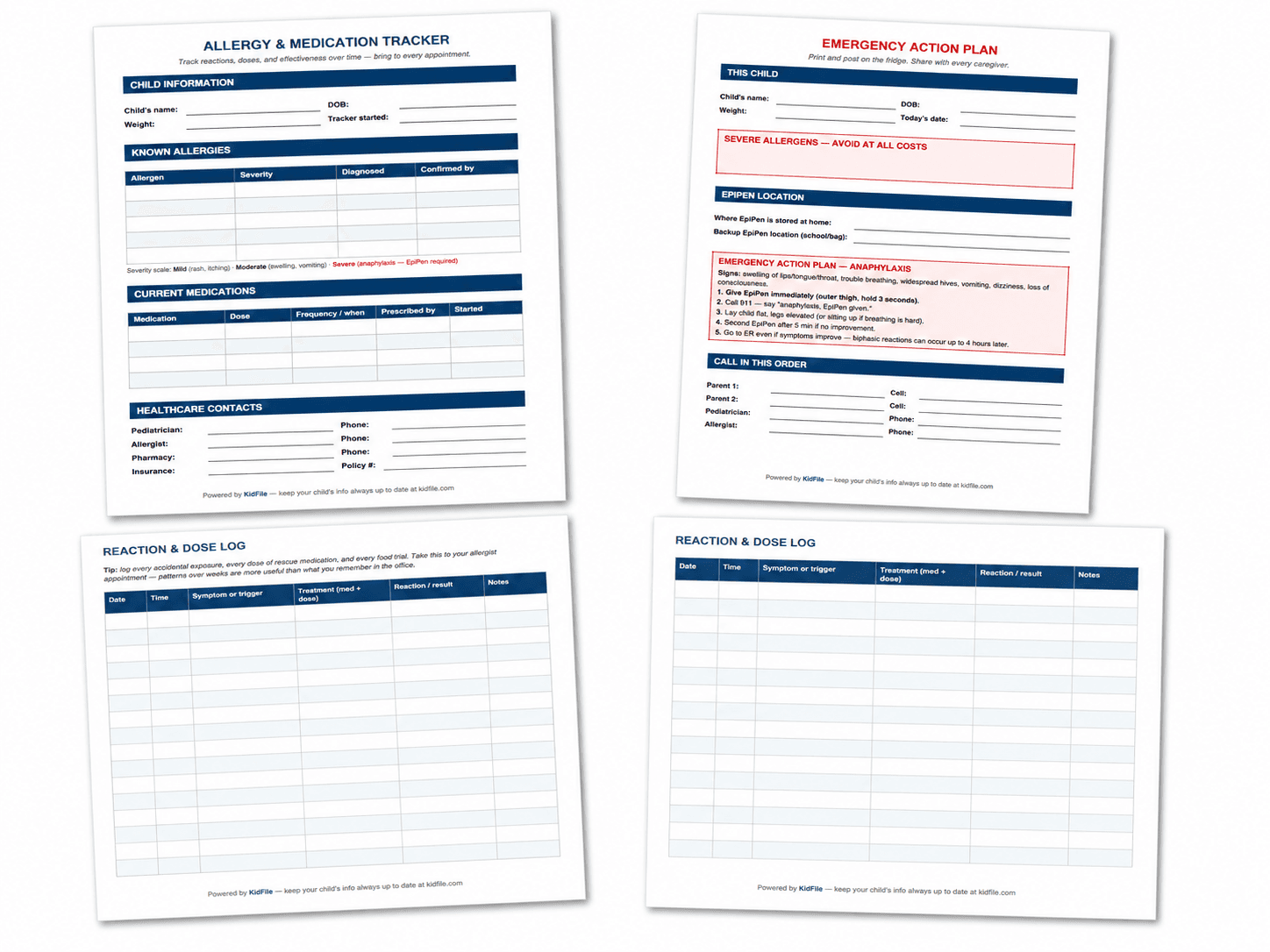
Short answer: An allergy and medication tracker should record your child's known allergens, current medications, healthcare contacts, an anaphylaxis emergency action plan, and a dated log of every reaction and dose. Download the free 3-page Kidfile template below — reference page, emergency action plan, and reaction log.
Download the template
- 📄Download PDF— print the 3 pages
- ✏️Download Editable Word doc— fill in on your computer
*Free. No email required. Includes anaphylaxis action plan as a separate, postable page.*
What's in the template
The template is built as three printable sections — each designed to live in a different place:
| Page | What it does | Where it lives |
|---|---|---|
| 1. Reference | Child info, allergen list with severity, current medications, healthcare contacts | In a binder or folder you bring to appointments |
| 2. Emergency Action Plan | Self-contained one-pager with severe allergens, EpiPen location, anaphylaxis steps, and emergency contacts | Posted on the fridge or wherever caregivers can see it |
| 3. Reaction & Dose Log | Grid for tracking date, time, symptom, treatment, reaction, notes | On the fridge or in the binder — fill in as events happen |
What the tracker looks like (filled in)
This example follows the Nguyen family during the first two months after their daughter Mia (age 4) was diagnosed with multiple food allergies — peanut, tree nut, and suspected sesame.
➡️ View the full filled-in example (PDF)
Notice how the log captures patterns: a school exposure on 9/8 led to a daycare ER visit on 9/21 (highlighted in red), and the documented sesame reaction on 9/15 led to confirmed diagnosis at the 9/30 allergist visit. Three weeks of disciplined logging produced a more accurate diagnosis than parent recall ever could.
What to track (and why each section matters)
After speaking with pediatric allergists and parents managing multiple-allergen households, these are the categories every tracker needs.
Known allergens with severity
For each allergen, record the severity (mild / moderate / severe / suspected), the date it was diagnosed, and how it was confirmed (skin test, blood test, oral challenge, or history). This matters because suspected allergies need different management than confirmed ones — and severity changes the emergency response.
Current medications
Medication name, dose (mg or mL — not just "a spoonful"), frequency, prescribing doctor, and start date. Doses change as kids grow. The "started" column helps the allergist see how long your child has been on a regimen.
Healthcare contacts
Pediatrician, allergist, pharmacy, insurance. These are the calls you'll make in a crisis — and the moment you have to look them up in your phone in the ER is the wrong moment.
Anaphylaxis emergency action plan
A separate one-pager every caregiver can follow without medical training. The American Academy of Pediatrics recommends every family with a severe allergy maintain a written plan. Include severe allergens, EpiPen location (home and backup), symptoms to watch for, step-by-step instructions, and emergency contacts.
Reaction and dose log
The most underused part of any tracker — and the most valuable to your allergist. Log:
- Accidental exposures (school lunch contamination, party incidents)
- Every dose of rescue medication (Benadryl, EpiPen, inhaler)
- Food trials (new foods you're testing at home, with allergist's OK)
- Routine daily doses (catches missed doses)
- Environmental triggers (pollen, pet dander) for context
Three weeks of log entries reveals patterns your memory won't.
A real parent moment (why this matters)
Composite story drawn from interviews with allergy parents.
"Our pediatrician thought our son had outgrown his egg allergy because he'd had baked egg twice with no reaction. The allergist looked at our log and said, 'But these two reactions on 6/2 and 7/14 — both within four hours of yogurt. That's not baked egg, that's raw egg. He's still allergic, just to one form.' We'd never have connected those two events without seeing them on the same page."
— Devon, dad of three
The pattern parents see: paper helps you spot what your brain misses.
Paper tracker vs. notes app vs. digital child profile
| Option | Strengths | Weaknesses |
|---|---|---|
| Paper tracker (this template) | Always visible on fridge; easy to print and bring to appointments; no battery; works for any caregiver | Updates require reprinting; only one location; can be lost |
| Phone notes app | Always in your pocket; easy to update | Only on your phone; sitters and school don't have access; no structure |
| Spreadsheet (Google Sheets) | Free; shareable; sortable by date or allergen | Designed for data, not caregivers in a panic |
| Child medical profile (Kidfile) | Auto-syncs to everyone you share with; structured for caregivers; appointment-ready exports | Requires setup |
For most parents during the first six months after diagnosis, paper plus a digital backup is the most resilient setup. Paper for the fridge and the appointment; digital for the school, the babysitter, and grandma.
How to use this tracker before an allergist appointment
The week before your appointment, do three things:
- 1. Review the log for patterns. Highlight any reactions that were unexpected, severe, or that involved a new food. Flag any patterns ("symptoms only with raw fruit," "reactions after outdoor play in spring").
- 2. Update the medication list. Cross out anything you've stopped. Add anything new. Note the date of the most recent dose change for each medication.
- 3. Print fresh copies. Bring the reference page, the log, and a blank log for the allergist to mark up if needed. Most allergists will scan the log into your child's chart.
This is the single most effective use of 15 minutes of prep time before any pediatric specialist appointment.
The limitation of paper (and what to do about it)
A paper tracker works well when:
- One parent is managing the medical info
- The child sees the same allergist every visit
- Caregivers don't change often
It falls short when:
- School needs the most current allergen list (and the version on file is 3 months old)
- Grandparents are watching the kids and need the EpiPen instructions in their hand
- A co-parent updates a dose but the other parent doesn't know
- The fridge copy is outdated but you can't remember what changed
This is where a digital child profile pays for itself. With Kidfile, you maintain one canonical version of your child's medical info — allergens, medications, contacts, emergency plan — and share read-only links with anyone who needs them. Update once; everywhere stays current.
Create your child's Kidfile
Keep your child's allergy and medication info in one place. Share with school, allergist, grandparents, and sitters. Update once, everywhere stays current.
Create your child's Kidfile →*Free. Takes 5 minutes. Designed by parents managing multi-allergen households.*
Frequently asked questions
What should an allergy and medication tracker include?
A complete tracker covers your child's known allergens with severity, current medications with doses, healthcare contacts, an anaphylaxis emergency action plan, and a dated log of every reaction, dose, and food trial. The log is the most valuable part for allergist appointments.
How do I track my child's allergic reactions?
Log every accidental exposure, food trial, and dose of rescue medication the day it happens. Record date, time, trigger, treatment given (med + dose), reaction outcome, and notes. Bring the log to every allergist appointment.
What is an anaphylaxis emergency action plan?
A one-page document caregivers can follow during a severe allergic reaction. It lists allergens, EpiPen location, symptoms to watch for, step-by-step instructions (give EpiPen, call 911, position child, second dose if needed, ER even if symptoms improve), and emergency contacts. Recommended by the AAP and FARE.
How do I keep track of multiple medications for my child?
Keep a single list with medication name, dose, frequency, prescribing doctor, and start date. Update it every time anything changes. For as-needed medications like Benadryl or rescue inhalers, log every use — this helps identify whether reactions are increasing.
Should I bring my allergy log to the allergist?
Yes. Allergists rely on what you can document, not what you can remember. A log of dates, triggers, and reactions reveals patterns that change treatment recommendations.
Is a paper allergy tracker enough or do I need an app?
Paper works well for one-caregiver households. It falls short when multiple caregivers (school, daycare, grandparents, co-parent) need the same medical info or when medications change often. A digital child profile that syncs across caregivers — like Kidfile — solves that.
Related templates from Kidfile
- Babysitter Information Sheet — for date-night sitters
Important medical disclaimer
This template is for informational and organizational purposes only. It does not replace medical advice from a qualified healthcare provider. For severe allergies, always follow the action plan provided by your child's allergist. In any suspected anaphylaxis, give epinephrine immediately and call 911. Information about anaphylaxis symptoms and steps was drawn from guidance by the American Academy of Pediatrics and Food Allergy Research & Education (FARE).